BLOG
Internships and job shadowing in the UAE, explained
Straight answers on permits, placements and programs, for students, parents and the companies that host them.
Job Shadowing in the UAE: A Practical Guide for Parents and Schools
What job shadowing is, how it differs from an internship, which careers suit it, and how your child turns one day into proof for university applications.

On this page
1 The short answer
Job shadowing means your child spends a day to a week alongside a professional, watching how the work actually gets done, asking questions and helping with small supervised tasks. It isn't a job, it's usually unpaid, and it's the cheapest way to test a career before committing years to a degree.
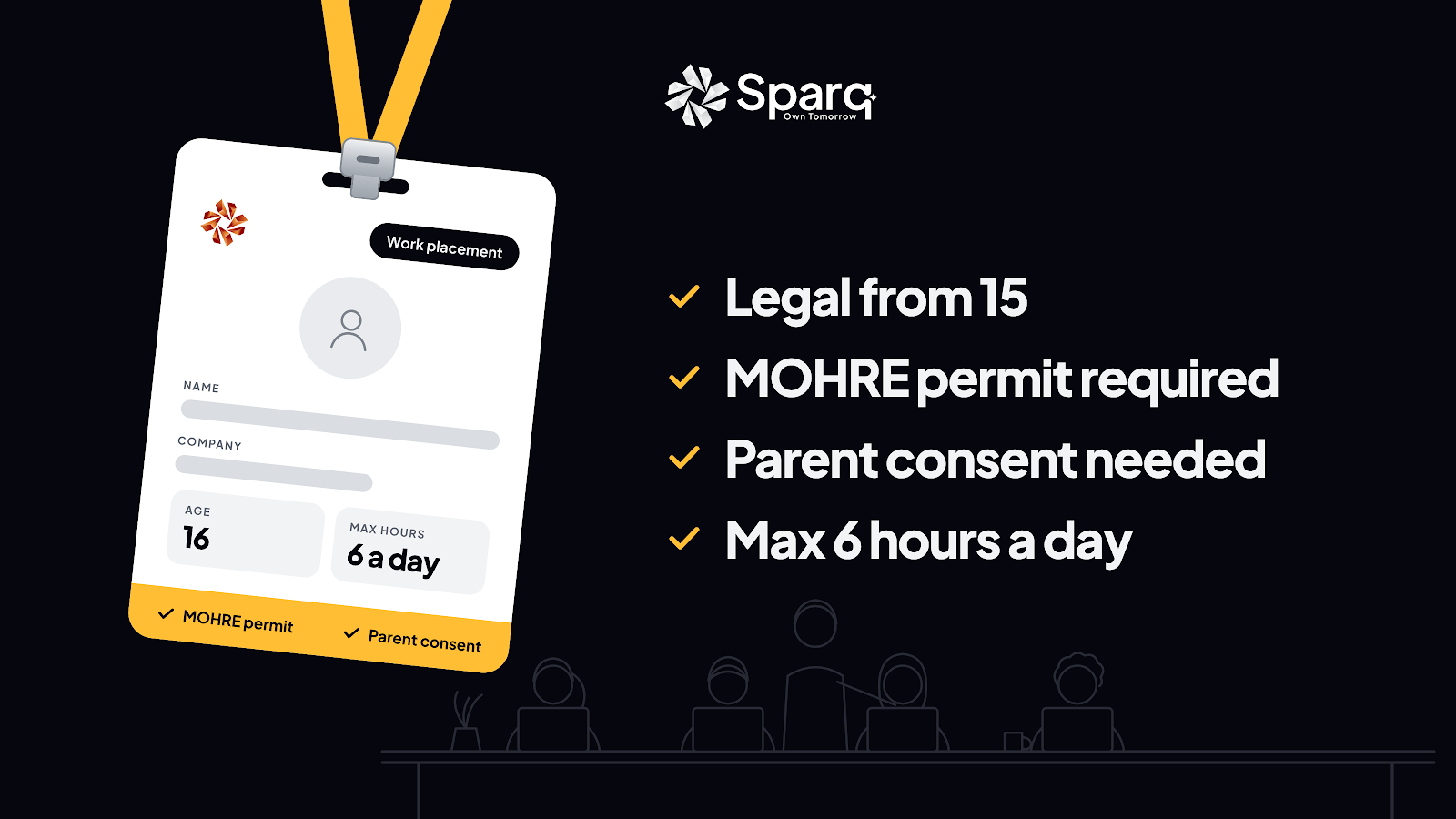
In the UAE, a student aged 15 to 18 on a placement is treated as being in training, so the company needs a MOHRE student training permit and your written consent. This guide covers how shadowing differs from an internship, what a good day looks like, and how to turn it into something that counts on a university application.
2 Job shadowing, internship or work experience: what's the difference?
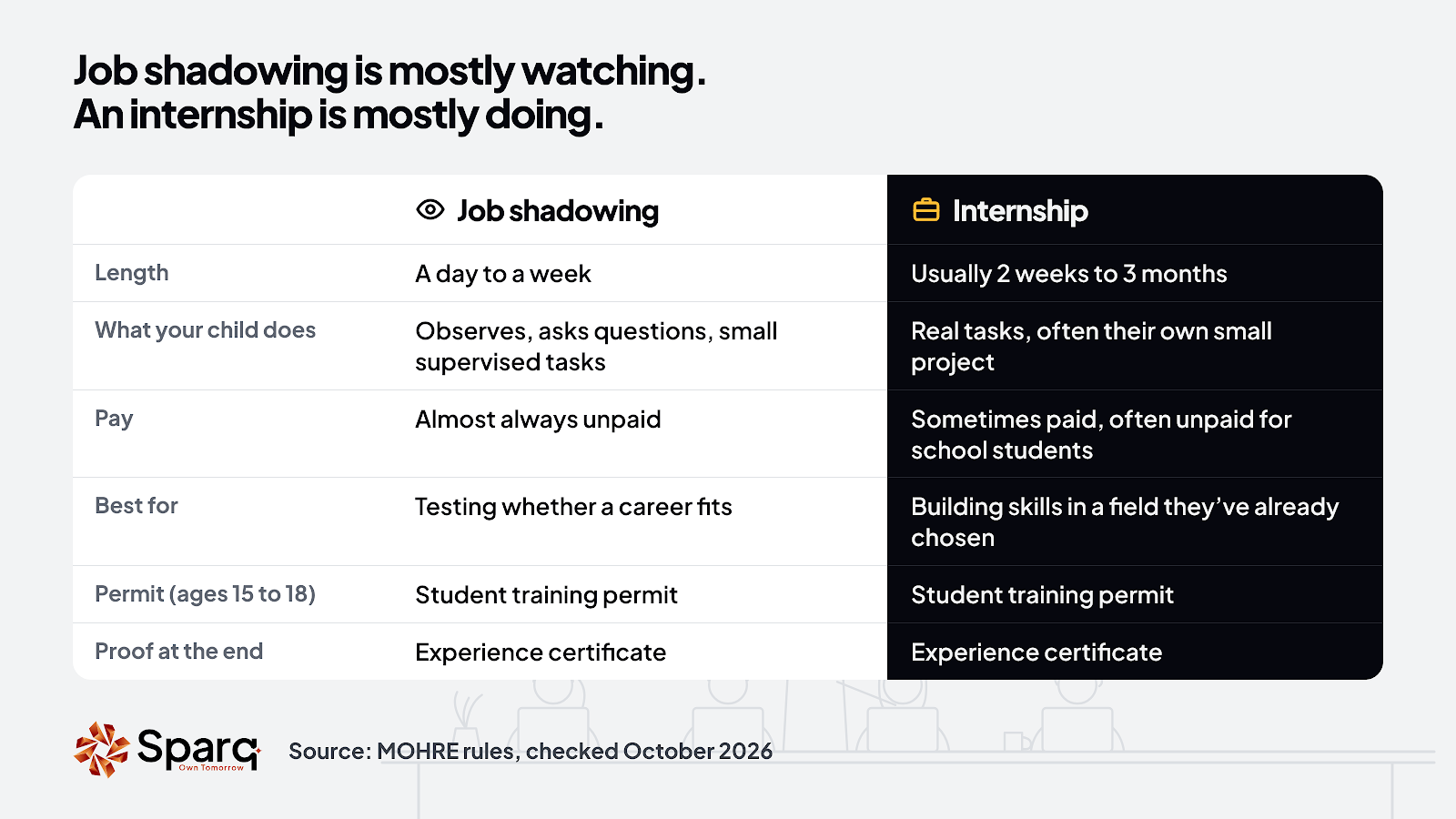
Job shadowing is mostly watching. An internship is mostly doing. "Work experience" is the umbrella term many British-curriculum schools use for either.
A useful way to think about it: shadowing answers "do I want to do this?" An internship answers "can I do this?" Most students benefit from the first question before the second.
3 What does a student actually do on a shadowing day?
Less than they expect to, and more than they'd see from a careers website. A well-run day usually follows a simple shape:
- Morning: a short introduction to the team and what the company does, then sitting in on whatever is already happening, such as a team meeting, a site visit or a client call.
- Midday: lunch with the team, which is often where the most honest answers come out.
- Afternoon: one small supervised task, like reviewing a design, drafting a social post or checking a set of figures, followed by time with the professional they're shadowing.
- End of day: a short debrief: what they saw, what surprised them, what they'd want to know more about.
If a day is just sitting in a corner watching someone answer emails, the company hasn't planned it. That's worth knowing before your child says yes, so ask what the day will involve.
4 Which careers suit job shadowing best?
Shadowing is most valuable in fields where a 16 year old can't do the work yet but can learn a lot by watching it.
- Healthcare: students see how a clinic or hospital team actually works. Expect extra paperwork and limits on what they can observe, because patient privacy comes first.
- Engineering and construction: site visits and design reviews show the gap between the textbook and the job.
- Law: sitting in on meetings and seeing how a case is prepared.
- Architecture and design: watching a project move from brief to drawing.
- Aviation: seeing the operational side most passengers never notice.
In fields like marketing, media, technology and finance, students can often do real tasks sooner, so a short internship may suit them better than pure shadowing.
5 How does my child get the most out of it?
The day itself is short. What happens either side of it decides whether it's worth anything. Share this part with your child.
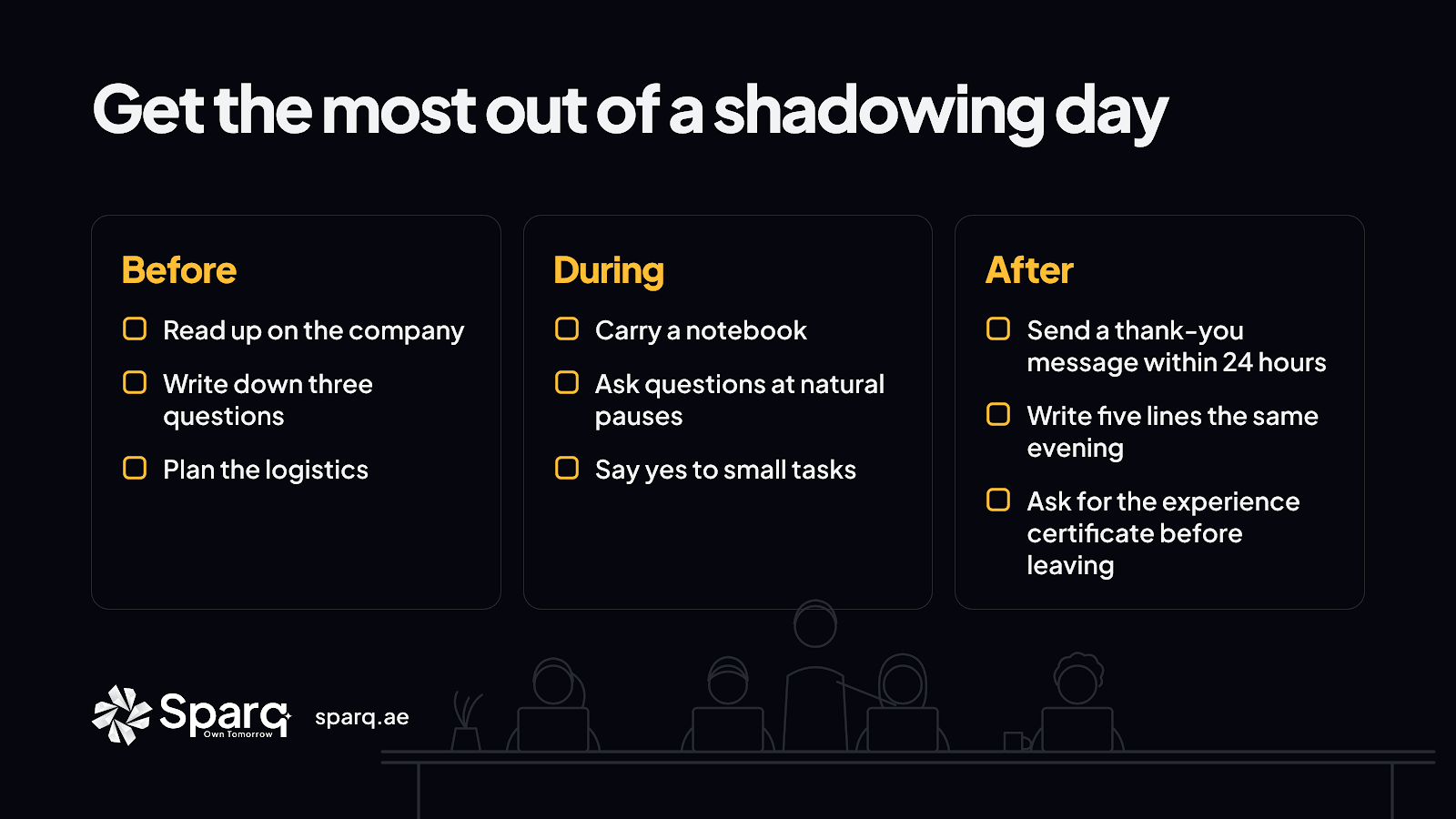
Before
- Read up on the company: what it does, who its clients are, and one recent project or piece of news.
- Write down three questions to ask. Good ones: "What does a normal week look like?", "What do you wish you'd known at 16?", "What would you study if you were starting again?"
- Plan the logistics: arrival time, dress code, who to ask for at reception.
During
- Carry a notebook. Writing things down signals interest and helps later.
- Ask questions at natural pauses, not in the middle of someone's task.
- Say yes to small tasks, even dull ones. That's often where the real work shows.
After
- Send a short thank-you message within 24 hours.
- Write five lines the same evening: what they did, what surprised them, what they liked, what they didn't, and whether they'd want to do it again.
- Ask for the experience certificate before they leave (more on this below).
Those five lines matter more than they look. Months later, they're the raw material for a personal statement, and they're far more convincing than "I am passionate about engineering."
6 How does a shadowing day become proof?
Through the experience certificate. Under the UAE's student training rules, the company must give a student an experience certificate at the end of the placement, covering their responsibilities and a performance appraisal.
That document does two jobs. It proves the placement happened, and it gives your child specific language to use in applications. Two tips:
- Ask for it before the last day. Once the student has left, it slips down everyone's to-do list.
- Keep a copy with the five-line note. Together they're the evidence behind any line on a CV or application.
Most university applications ask students to show how they've explored their subject outside the classroom. A certificate plus a few honest sentences about what they learned answers that far better than a list of activities.
7 For schools: how to build shadowing into the year
The student training rules are built around academic holidays, with placements of up to three consecutive months at a time. So shadowing works best when it's planned into the school calendar rather than squeezed into term time.
- Plan around the breaks. Winter, spring and summer holidays are the natural windows. Tell students and parents a term ahead.
- Prepare the no-objection letter in advance. Every student training placement needs one from the school. A ready template saves counsellors a lot of last-minute requests.
- Debrief afterwards. A short conversation or written reflection turns a placement into material for references and applications.
- Track what happened. Which students went, which fields, what they took away. Over time that shows which placements are worth repeating.
8 Where can my child find job shadowing in the UAE?
Sparq lists job shadowing and internship placements from UAE companies for students aged 16 to 18 and university students. Your child builds one profile, applies to placements across sectors, and can look for the Verified Employer badge, which shows a company has submitted its trade license.
Create your child's profile on Sparq https://sparq.ae/en/member
9 FAQ
Is job shadowing paid in the UAE?
Almost never. Student training placements can be unpaid, though companies are encouraged to cover expenses. Anything agreed must be written into the contract.
At what age can my child job shadow in the UAE?
From 15, with a MOHRE student training permit, your written consent and a no-objection letter from their school.
Does a single day of shadowing need a permit?
The rules don't carve out short visits, so a careful company treats any structured time on site as training. If a company says no permit is needed, ask why.
Can job shadowing happen during term time?
Student training placements are designed for academic holidays. Check with the school before agreeing to anything in term time.
Does job shadowing help with university applications?
Yes, when it's documented. An experience certificate plus a short, honest account of what your child learned shows real interest in their subject.
What's the difference between job shadowing and an internship?
Shadowing is mostly observing for a day to a week. An internship is mostly doing real tasks, usually for two weeks to three months.
10 Sources
Checked on 13 October 2026. Rules change, so confirm with MOHRE before any placement starts.
- Khaleej Times: Internships in UAE, work hours, age, job restrictions (student training rules: holidays, up to 3 months, documents, experience certificate)
- UAE Government portal: Legal provisions for employing minors (juvenile work and training conditions)
- Gulf News: Summer internships in the UAE, what students and parents need to know (who applies for the permit)
Found this useful? Share it.
Send it to someone who would want to read it.