المدونة
ما نتعلمه
ملاحظات من الميدان: ما يقوله الطلبة، وما تطلبه جهات العمل، وما نغيّره بناءً على ذلك.
Every Senior Hire Was Someone's Intern Once: The Business Case for Internships in the UAE
Employers want experience, AI is taking the junior work, and someone has to train tomorrow's managers. Why internships are a pipeline, not a favor.
في هذه الصفحة
1 The short answer
Internships aren't a favor to students. They're how a company builds the people it will promote in five years' time.
Employers across the UAE want candidates who arrive with experience. AI is taking over much of the junior work that used to provide it. And the data on interns is consistent: people who interned with a company tend to stay longer once hired. If nobody gives graduates their first experience, the shortage of good mid-level talent stops being a market problem and becomes yours.
2 The experience paradox
Every company wants to hire people with experience. Somebody has to give them their first.
This isn't new. When Bayt.com and YouGov surveyed fresh graduates across the Middle East and North Africa in 2017, the biggest challenge they reported was that employers were looking for candidates with previous work experience (52%). Three in four said industries hesitate to hire graduates because they lack experience.
What has changed is that the gap is getting wider. In 2026, UAE recruiters describe internships, portfolios and project work as the new minimum for an entry-level role. The first rung of the ladder now has a rung below it, and that rung is an internship.
3 What happens when AI takes the junior work?
UAE employers are hiring fewer people at entry level, according to Indeed data reported by Khaleej Times in 2026. One consultant quoted in that report put it plainly: the research, first drafts and admin tasks companies used to give graduates are now done by AI in seconds.
That saves money this year. It creates a problem later. Junior roles were never only about the tasks. They were where people learned how your business works, who to call, and what good looks like. Remove them, and in five years there's nobody ready for the mid-level roles AI can't do.
A structured internship program is one of the few ways to keep that learning happening without carrying a full junior headcount. Students get real exposure; you get to see who's worth hiring before you commit.
4 What do the pipeline numbers say?
The longest-running data on this comes from NACE, the US National Association of Colleges and Employers, which surveys employers on their intern programs every year. There's no equivalent UAE dataset yet, so treat these as a benchmark rather than a local result.
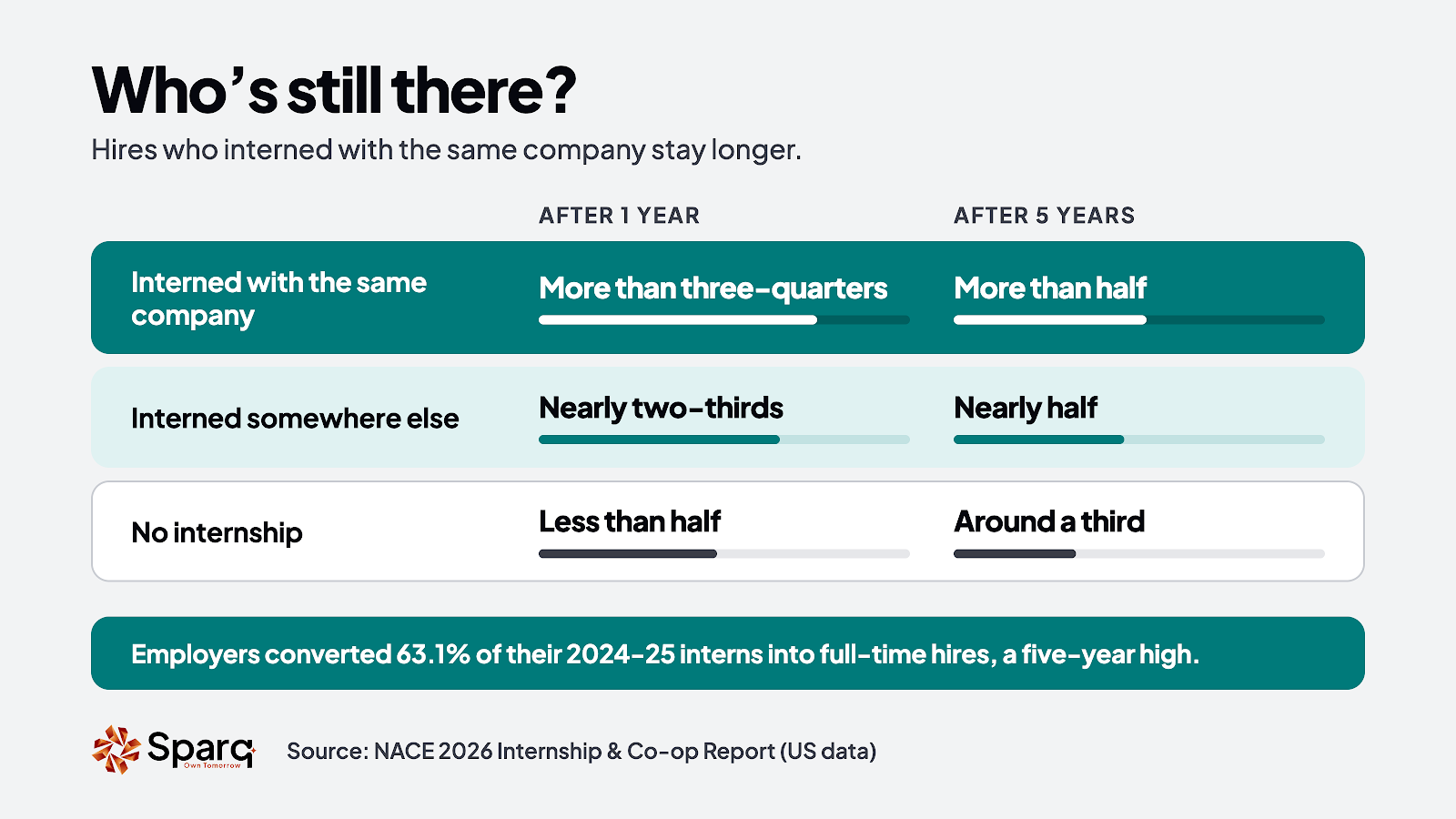
From NACE's 2026 Internship & Co-op Report found employers converted 63.1% of their 2024-25 interns into full-time hires, the highest rate in five years.
The pattern has held in NACE's data for over a decade: people who know what they're signing up for tend to stay. An internship is a trial that works in both directions.
5 Merit over connections
In the UAE, who you know still plays a big part in landing a first job. A recruitment consultant said as much to Khaleej Times this year.
That's a problem for students without the right network, and it's a problem for companies too. If your first-job pipeline runs on referrals and family friends, you're choosing from a small, familiar pool and missing the students who would have outworked everyone in it.
An open internship program, where any student can apply and every application is judged on what they've done, widens that pool. It's fairer, and it's better recruiting.
6 Internships and the S in ESG
ESG reporting is mandatory for companies listed on ADX and DFM, and investors are paying more attention to the social side: how a company develops people and what it contributes to the community around it. The DFM's reporting guide sets out 32 ESG metrics as a benchmark for listed companies.
Most CSR activity is hard to measure. An internship program isn't. You can report how many students you hosted, from which schools and universities, how many completed, what they said about it, and how many you later hired.
For listed companies, that's a social contribution backed by numbers rather than photos. For private companies, it's the same evidence for clients, partners and anyone who asks what you give back.
7 Where Emirati talent comes in
For mainland companies with Emiratisation targets, internships put you in front of Emirati students years before they graduate, in the fields you'll need to hire from.
A standard internship hasn't been confirmed to count towards your quota. But an Emirati student hired on a Studying Citizen Employment Contract, under a Nafis-approved program, does. Students who already know your team are the most natural candidates for that contract.
We cover who has to comply, and what counts, in Emiratisation in 2026: does your company actually have to comply?
8 What this looks like for medium and large companies
Large companies
- Run interns as a cohort, with a start date, a shared induction and a final showcase.
- Set a conversion target per function, and hold hiring managers to it.
- Bring back strong interns for a second placement before graduation. In NACE's data, nearly 9 in 10 returning interns were offered a full-time job.
- Use school-age job shadowing as your community program, and university internships as your hiring program. Keep the two separate so neither gets diluted.
Medium companies
- Start with two or three university interns in one team that has a real project and a willing manager.
- Add a few days of job shadowing for school students each holiday. It costs little, and it builds your name with families and schools.
- Don't copy a big company's program. A good supervisor and a clear brief matter more than a polished induction deck.
The practical side, from permits to a week-by-week plan, is in How to run an internship program your team won't hate.
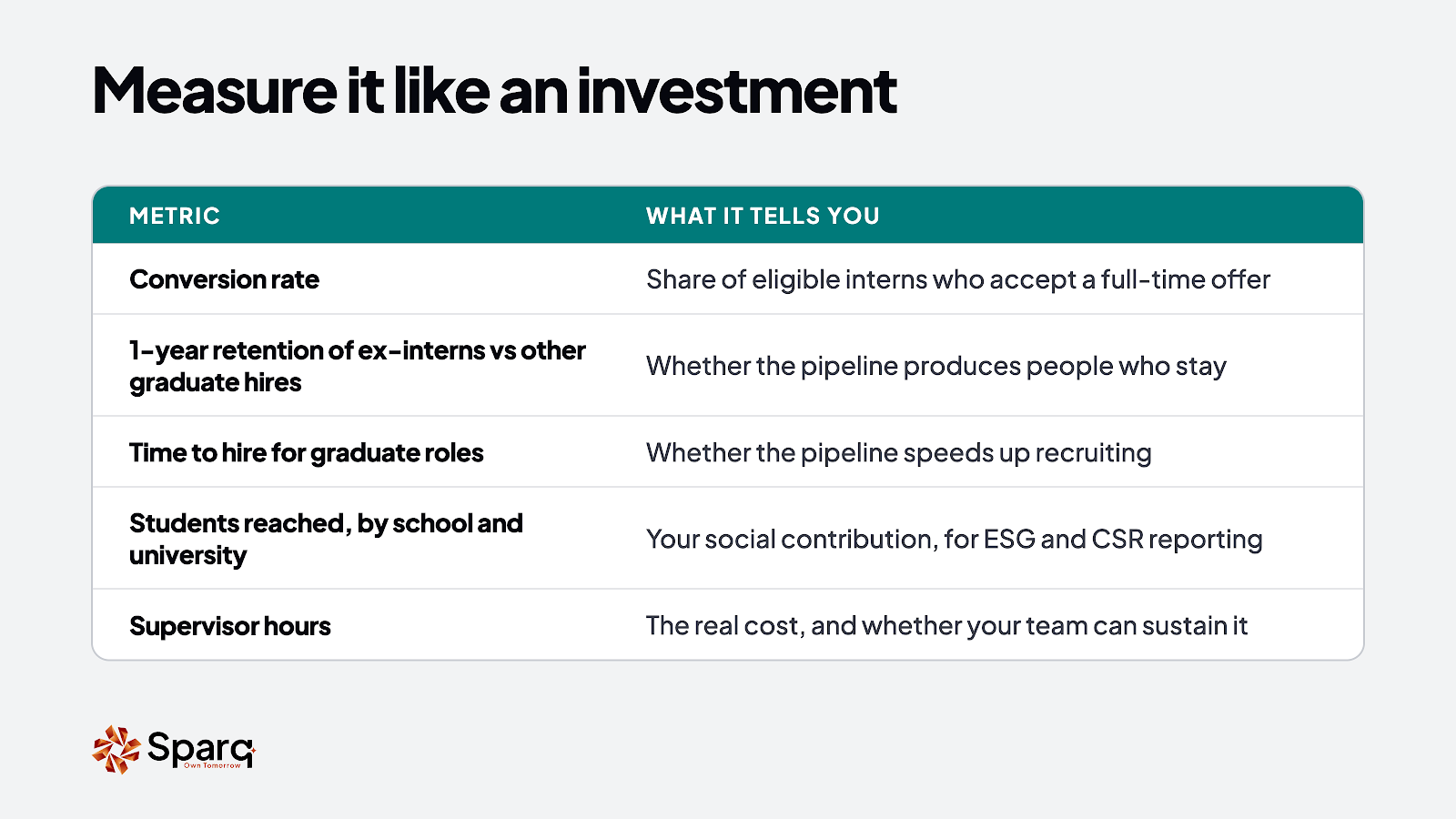
9 What should you measure?
If internships are an investment, track them like one. Five numbers cover most of it. Compare yourself with yourself, year on year. The first year sets your baseline.
10 Pay it forward
Everything above is the business case. This part isn't.
Think about the most senior people in your company. Almost every one of them can name the person who gave them a first chance: a manager who took a risk on an intern, a client who let a junior run the meeting, a founder who answered a cold email. They didn't earn that chance with experience. Someone simply decided they were worth teaching.
The UAE's next generation of managers is in school and university right now. Whether they get that same chance depends on companies like yours deciding it's worth the effort.
Sparq makes the effort smaller. Your internship program today is probably a mess of WhatsApp, spreadsheets and email. Sparq replaces that with one platform, for school and university students, with the reporting to show what your program achieved.
Register you company with Sparq and start offering internships here
11 FAQ
Why should companies offer internships?
To build a hiring pipeline. Interns who join full time tend to stay longer, and you see their work before you commit to a hire.
Do interns stay longer once hired?
In US data from NACE, more than three-quarters of hires who interned with the same company stayed at least a year, compared with less than half of hires with no internship.
Is AI reducing entry-level jobs in the UAE?
UAE recruiters report fewer entry-level openings, partly because AI now handles tasks like research, first drafts and admin that graduates used to do.
Can internships count as CSR or ESG activity?
Yes. Students hosted, completion rates and later hires are measurable social outcomes you can include in CSR or ESG reporting.
Do internships help with Emiratisation?
Indirectly. A standard internship isn't confirmed to count towards targets, but it introduces you to Emirati students you may later hire, including on a Studying Citizen Employment Contract, which does count.
How many interns should a medium-sized company start with?
Two or three, in one team with a real project and a named supervisor. Grow it once that works.
12 Sources
Checked on 13 October 2026.
- NACE: Internship program retention rates underscore long-term ROI (2026 report: 1-year and 5-year retention, 63.1% conversion. US data)
- NACE: Are returning interns more likely to convert? (2015 survey: offers to returning interns. US data)
- YouGov and Bayt.com: Six in 10 fresh graduates want to work in the UAE (2017 MENA survey: experience as the top barrier)
- Khaleej Times: Fresh graduates face shrinking opportunities as entry-level jobs decline (2026: AI, entry-level roles, internships as the new minimum, networking)
- DMCC: ESG reporting in the UAE (mandatory reporting for ADX and DFM listed companies, DFM's 32 metrics)
- MOHRE: Studying Citizen Employment Contract (counts towards Emiratisation targets)
- The National: UAE school leavers matched with placements (ManpowerGroup Q4 2026: UAE Net Employment Outlook 41%, early-career hiring rising at nearly half of UAE organisations)